Difference between revisions of "824 - Construction Surveying and Staking"
m (Clarkj25 moved page 824 - Contractor Staking to 824 - Construction Surveying and Staking: Spec book name change) |
|||
| (65 intermediate revisions by the same user not shown) | |||
| Line 2: | Line 2: | ||
<center><span STYLE="font: 60pt arial;">'''824'''</span></center> | <center><span STYLE="font: 60pt arial;">'''824'''</span></center> | ||
| − | <center><span STYLE="font: 40pt arial;">''' | + | <center><span STYLE="font: 40pt arial;">'''Construction Surveying and Staking'''</span></center> |
| − | |||
| − | |||
{{top}} | {{top}} | ||
| Line 14: | Line 12: | ||
==[[#GENERAL DESCRIPTION|'''GENERAL DESCRIPTION''']]== | ==[[#GENERAL DESCRIPTION|'''GENERAL DESCRIPTION''']]== | ||
| − | |||
| + | ===[[#Engineer Responsibilities|Engineer Responsibilities]]=== | ||
| + | The Engineer is always responsible for the requirements listed in 824.03A. The Engineer must review the requirements of each staking item for approvals and verifications as necessary for each staking task | ||
| + | If the contractor staking pay item is not included in the project, then the Engineer is also responsible for work as defined in 824.03 C - 824.03R. | ||
| + | The Engineer should contact the Contractor to verify the Engineer staking tasks based on the contract needs. If deviating from section 824.03A staking intervals, document the revisions with the Contractor. | ||
{{top}} | {{top}} | ||
| − | |||
| − | |||
| − | + | ===[[#Contractor Responsibilities|Contractor Responsibilities]]=== | |
| − | ===[[# | + | If the contractor staking pay item is included in the project then the Contractor is responsible for work as defined in 824.03B - 824.03W. |
| − | |||
{{top}} | {{top}} | ||
| − | |||
| − | |||
| − | + | ===[[#Control Verification & Establishment|Control Verification & Establishment]]=== | |
| − | ===[[# | + | The Engineer is responsible for verifying horizontal and vertical control prior to the start of construction. Control verification and establishment activities should be documented. An example control summary form and control verification table are listed below. Additional control may be required depending on other contract special provisions, for example, the Special Provision for Automated Machine Guidance. |
| − | |||
{{top}} | {{top}} | ||
| − | ==[[# | + | ====[[#Control Verification and Establishment Form|Control Verification and Establishment Form]]==== |
| − | |||
| − | |||
| − | |||
| − | |||
| − | + | :[https://mdotwiki.state.mi.us/images_construction/6/64/CONTROL_VERIFICATION_AND_ESTABLISHMENT_SUMMARY.docx Control Verification and Establishment Summary Form] | |
| − | |||
| − | |||
| − | |||
| − | |||
| − | |||
| − | |||
| − | |||
| − | |||
| − | + | =====[[#Example Control Verification and Establishment Form|Example Control Verification and Establishment Form]]===== | |
| − | ===[[# | ||
| − | |||
| − | |||
| − | |||
| − | |||
| − | + | [[File:CONTROL VERIFICATION AND ESTABLISHMENT SUMMARY - EXAMPLE.pdf|thumb|center|750px|link=https://mdotwiki.state.mi.us/images_construction/b/b6/CONTROL_VERIFICATION_AND_ESTABLISHMENT_SUMMARY_-_EXAMPLE.pdf|'''Example - Control Verification and Establishment Summary''']] | |
| − | |||
| − | ===[[# | + | {{top}} |
| − | + | ====[[#Control Verification Table Form|Control Verification Table Form]]==== | |
| − | |||
| − | |||
| − | |||
| − | |||
| − | |||
| − | [https://mdotwiki.state.mi.us/images_construction/ | + | :[https://mdotwiki.state.mi.us/images_construction/3/3e/Control_Verification_Table.xlsx Control Verification Table Form] |
| − | |||
| + | =====[[#Example Control Verification Table|Example Control Verification Table]]===== | ||
| − | + | [[File:Control Verification Table - Example.pdf|thumb|center|750px|link=https://mdotwiki.state.mi.us/images_construction/7/7c/Control_Verification_Table_-_Example.pdf|'''Example - Control Verification Table''']] | |
| − | |||
| − | |||
| − | |||
| − | |||
| − | |||
| − | |||
| − | |||
| − | |||
| − | |||
| − | |||
| − | |||
| − | |||
| − | |||
| − | |||
| − | |||
| + | {{top}} | ||
| + | ===[[#Contractor Prequalification|Contractor Prequalification]]=== | ||
<span style="color: red"> -Reserved- </span> | <span style="color: red"> -Reserved- </span> | ||
{{top}} | {{top}} | ||
| − | |||
| − | |||
| − | + | ==[[#MATERIALS|'''MATERIALS''']]== | |
| − | |||
<span style="color: red"> -Reserved- </span> | <span style="color: red"> -Reserved- </span> | ||
{{top}} | {{top}} | ||
| − | |||
| − | |||
| − | + | ==[[#EQUIPMENT|'''EQUIPMENT''']]== | |
| − | |||
<span style="color: red"> -Reserved- </span> | <span style="color: red"> -Reserved- </span> | ||
{{top}} | {{top}} | ||
| − | ==[[# | + | ==[[#PRECONSTRUCTION|'''PRECONSTRUCTION''']]== |
| − | ===[[# | + | ===[[#Contractor Submitted Plans/Procedures|Contractor Submitted Plans/Procedures]]=== |
| − | + | ||
| + | ====[[#Contractor Staking Quality Control Plan (CSQC)|'''Contractor Staking Quality Control Plan (CSQC)''']]==== | ||
| − | + | The contractor quality control plan is an important communication tool that identifies key contacts, quality control procedures, documentation methods, equipment certification, staking tolerances, and field equipment check procedures. | |
| − | |||
| − | |||
| − | + | [https://mdotwiki.state.mi.us/images_construction/9/91/CONTRACTOR_STAKING_QC_PLA1.docx CONTRACTOR STAKING QUALITY CONTROL PLAN] | |
| − | + | [https://mdotwiki.state.mi.us/images_construction/8/85/CONTRACTOR_STAKING_QC_PLAN.docx CONTRACTOR STAKING QUALITY CONTROL PLAN EXAMPLE] | |
| − | |||
{{top}} | {{top}} | ||
| + | ====[[#CSQC Quality Control Staff|CSQC Quality Control Staff]]==== | ||
| + | *The licensed professional surveyor named in the quality control plan should be the individual responsible for providing professional oversight of the staking activities. This person does not need to serve as the plan manager or site contact, but may do so if appropriate. | ||
| + | {{top}} | ||
| + | ====[[#CSQC Equipment Calibration|CSQC Equipment Calibration]]==== | ||
| + | *Copies of equipment certification for levels, transits, lasers, and total stations should be provided to the Engineer. Equipment should be calibrated at a minimum on an annual basis and as needed throughout the project. Field checks should be performed and documented. | ||
| + | {{top}} | ||
| + | =====[[#CSQC Equipment Certification|CSQC Equipment Certification]]===== | ||
| + | Provide equipment calibration certification documentation for levels, transits, lasers, and total stations. Calibration certifications must be completed by a third-party verifying that equipment meets the accuracy requirements as specified by the manufacturer. | ||
| − | + | doc links | |
| − | |||
{{top}} | {{top}} | ||
| + | ====[[#CSQC Onsite Field Equipment Checks|CSQC Onsite Field Equipment Checks]]==== | ||
| + | Check and test equipment prior to use and per manufacturer’s specifications. Perform additional checks if equipment accuracy becomes questionable due to impacts, environmental conditions, or observed inconsistencies. | ||
| + | #'''Method of Field Verification''' Perform field checks in accordance with the Design Survey Manual and the Survey Standards of Practice procedures and manufacturer-recommended methods applicable for the equipment used. Document all verification activities, including the method, readings, and adjustments made during the project and provide to the Engineer. | ||
| + | #'''Documentation''' Submit field verification records to the Engineer. Records must include: | ||
| + | ##Date of field verification | ||
| + | ##Equipment type, model, and serial number | ||
| + | ##Verification method used | ||
| + | ##Recorded readings and any adjustments | ||
| + | ##Confirmation of compliance with tolerance limits | ||
| + | {{top}} | ||
| + | =====[[#CSQC Non-Compliant Equipment|CSQC Non-Compliant Equipment]]===== | ||
| + | Remove equipment immediately from service if it is found to be out of tolerance during checks. Recalibrate and recertify the equipment before returning to service. Notify the Engineer and provide recalibration and recertification documentation. | ||
| − | + | {{top}} | |
| − | |||
| − | |||
| + | ==[[#CONSTRUCTION|'''CONSTRUCTION''']]== | ||
| + | ===[[#Staking|'''Staking''']]=== | ||
| + | Construction staking translates road and bridge plans into physical markers on the ground, with precise locations for structures, utilities and grades (horizontally and vertically) using equipment with the appropriate equipment tolerances for the staking task such as total stations, GPS and levels. It’s a crucial step to ensure everything is built to design specifications, from the foundation layouts to the final elevations, using cut/fill information for exact placement. When staking it is important to always check into more than one control point or benchmark. | ||
| + | Before construction starts it is the Engineers responsibility to verify existing control points and benchmarks against the control points and benchmarks in the survey information sheet. The Engineer will document any discrepancies in the existing control values and will update the control values as needed. Verification of existing control points and benchmarks is critical as ground conditions can lead to the settling or shifting of control points over time. | ||
| + | When Contractor staking is used the contractor will loop and set any additional control for the project (824.03B). It important to notify the Engineer at least two working days before moving benchmarks or control points. After moving and or setting additional points the Contractor will provide the Engineer with a list of points including the calculations and descriptions of the new locations within two days. When moving a benchmark or control point it is important not to name it the same as the existing point. For example if point 205 needs to be moved then rename it 205A so that it is not confused with the original location and values of point 205. | ||
| + | The Contractor must make a reasonable effort to preserve stakes set by the Engineer and/or Contractor. The Contractor is responsible for replacing stakes and benchmarks lost or destroyed by Contractor operations at no additional cost to the Department. The Engineer must verify replacement stakes or benchmarks. | ||
| + | If Contractor staking is not used on the project, it is the Contractors responsibility to notify the Engineer immediately of the stakes and benchmarks that are lost or destroyed. The cost to replace the stakes and benchmarks lost or destroyed will be reimbursed to the Department at the same rate as Staking Plan Errors and Extras listed in subsection 824.04. | ||
| − | + | The staking and verifying of construction points, lines and grades is crucial in road and bridge design for safety, functionality and longevity, ensuring proper drainage, structural integrity, smooth transitions, adequate sightlines and adherence to plans, to prevent failures, crashes, and costly rework by aligning physical construction with design intent. The Engineer is responsible for verifying the foundation's line and grade after excavation and before placing structural components like pier caps or abutment walls. The contractor is required to perform any necessary adjustments or corrective work based on the Engineer's verification at no extra cost to the Department. | |
| − | The | + | Survey staking tolerances can vary significantly by project and feature but generally ranges from very tight for critical elements like structures and larger tolerances for less critical items like earthwork. Tolerances stated for each type of stake indicate the acceptable deviation of the position of each stake from its computed position relative to the given alignment and grade. Staking tolerances are project-specific and can vary based on the design and contractual requirements. |
| − | |||
| − | |||
| − | |||
| − | |||
| − | |||
| − | |||
| − | |||
{{top}} | {{top}} | ||
| + | ===[[#Ancillary Structures|'''Ancillary Structures''']]=== | ||
| − | + | Ancillary structures often present complex staking challenges due to alignment requirements and proximity to other construction features. The horizontal and vertical location of foundations, including but not limited to top of foundation elevation, bolt pattern orientation, and bolt projection, should be independently verified prior to concrete placement to ensure proper positioning. An as-built survey should be completed to document the final locations and confirm conformance with project plans. These verification activities should occur prior to structure installation. All verification results and as-built data should be submitted to the Engineer for review. | |
| − | + | doc link | |
| − | |||
| − | |||
| − | ===[[# | + | ===[[#Layout / Survey|'''Layout / Survey''']]=== |
<span style="color: red"> -Reserved- </span> | <span style="color: red"> -Reserved- </span> | ||
{{top}} | {{top}} | ||
| − | ===[[# | + | ===[[#Use of Automated Machine Guidance (AMG)|'''Use of Automated Machine Guidance (AMG)''']]=== |
| − | + | The following information will serve as guidance for the administration of projects that incorporate the Special Provision for Automated Machine Guidance (AMG). The documentation is specific for AMG projects and supplements information for the Engineer in the special provision for the administration of AMG work. These procedures apply to all federal and state funded projects that use the AMG process. | |
| − | + | [[File:CMU16-001 AMG Attachment Final.pdf|500px|thumbnail|center|Automated Machine Guidance]] | |
| − | + | [[File:CMU16-001 AMG Sample Work Plan Final.pdf|500px|thumbnail|center|AMG Sample Work Plan]] | |
| − | |||
| − | + | [[File:CMU16-001 AMG Verification Form Final.pdf|500px|thumbnail|center|AMG Verification Form]] | |
| − | |||
| − | |||
{{top}} | {{top}} | ||
| + | ===[[#As-Built Plans |'''As-Built Plans''']]=== | ||
| − | + | Preparation of as-built plans should follow the guidelines set forth in section 109.07 109.07 Final Marked Plans and Section 14.73.01 of the MDOT English Road Design Manual. | |
| − | |||
| − | |||
| − | |||
{{top}} | {{top}} | ||
| − | + | ==[[#INSPECTION & TESTING|'''INSPECTION & TESTING''']]== | |
<span style="color: red"> -Reserved- </span> | <span style="color: red"> -Reserved- </span> | ||
{{top}} | {{top}} | ||
| − | + | ==[[#MEASUREMENT, DOCMENTATION & PAYMENT|'''MEASUREMENT, DOCMENTATION & PAYMENT''']]== | |
<span style="color: red"> -Reserved- </span> | <span style="color: red"> -Reserved- </span> | ||
{{top}} | {{top}} | ||
| − | |||
| − | |||
| − | |||
| − | |||
| − | |||
| − | |||
| − | |||
[[Category:Construction Manual]] | [[Category:Construction Manual]] | ||
| Line 224: | Line 179: | ||
[[Category: Section 824]] | [[Category: Section 824]] | ||
[[Category:New CM Format]] | [[Category:New CM Format]] | ||
| − | |||
| − | |||
| − | |||
| − | |||
| − | |||
| − | |||
| − | |||
| − | |||
| − | |||
| − | |||
| − | |||
| − | |||
| − | |||
| − | |||
| − | |||
| − | |||
| − | |||
| − | |||
| − | |||
Latest revision as of 14:46, 5 March 2026
GENERAL DESCRIPTION
Engineer Responsibilities
The Engineer is always responsible for the requirements listed in 824.03A. The Engineer must review the requirements of each staking item for approvals and verifications as necessary for each staking task If the contractor staking pay item is not included in the project, then the Engineer is also responsible for work as defined in 824.03 C - 824.03R. The Engineer should contact the Contractor to verify the Engineer staking tasks based on the contract needs. If deviating from section 824.03A staking intervals, document the revisions with the Contractor.
Contractor Responsibilities
If the contractor staking pay item is included in the project then the Contractor is responsible for work as defined in 824.03B - 824.03W.
Control Verification & Establishment
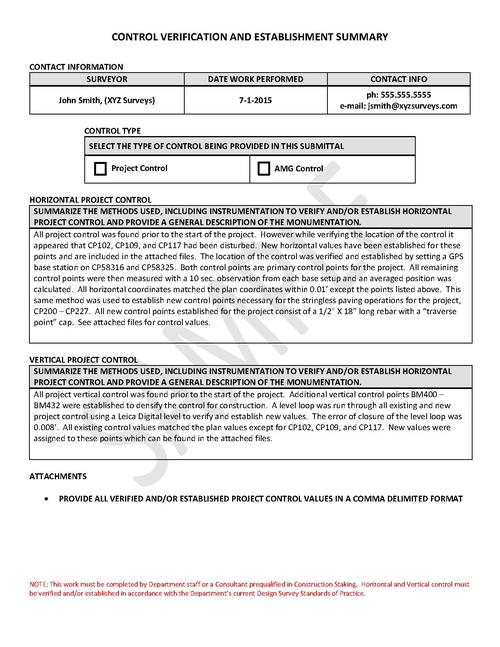
The Engineer is responsible for verifying horizontal and vertical control prior to the start of construction. Control verification and establishment activities should be documented. An example control summary form and control verification table are listed below. Additional control may be required depending on other contract special provisions, for example, the Special Provision for Automated Machine Guidance.
Control Verification and Establishment Form
Example Control Verification and Establishment Form

Control Verification Table Form
Example Control Verification Table

Contractor Prequalification
-Reserved-
MATERIALS
-Reserved-
EQUIPMENT
-Reserved-
PRECONSTRUCTION
Contractor Submitted Plans/Procedures
Contractor Staking Quality Control Plan (CSQC)
The contractor quality control plan is an important communication tool that identifies key contacts, quality control procedures, documentation methods, equipment certification, staking tolerances, and field equipment check procedures.
CONTRACTOR STAKING QUALITY CONTROL PLAN
CONTRACTOR STAKING QUALITY CONTROL PLAN EXAMPLE
CSQC Quality Control Staff
- The licensed professional surveyor named in the quality control plan should be the individual responsible for providing professional oversight of the staking activities. This person does not need to serve as the plan manager or site contact, but may do so if appropriate.
CSQC Equipment Calibration
- Copies of equipment certification for levels, transits, lasers, and total stations should be provided to the Engineer. Equipment should be calibrated at a minimum on an annual basis and as needed throughout the project. Field checks should be performed and documented.
CSQC Equipment Certification
Provide equipment calibration certification documentation for levels, transits, lasers, and total stations. Calibration certifications must be completed by a third-party verifying that equipment meets the accuracy requirements as specified by the manufacturer.
doc links
CSQC Onsite Field Equipment Checks
Check and test equipment prior to use and per manufacturer’s specifications. Perform additional checks if equipment accuracy becomes questionable due to impacts, environmental conditions, or observed inconsistencies.
- Method of Field Verification Perform field checks in accordance with the Design Survey Manual and the Survey Standards of Practice procedures and manufacturer-recommended methods applicable for the equipment used. Document all verification activities, including the method, readings, and adjustments made during the project and provide to the Engineer.
- Documentation Submit field verification records to the Engineer. Records must include:
- Date of field verification
- Equipment type, model, and serial number
- Verification method used
- Recorded readings and any adjustments
- Confirmation of compliance with tolerance limits
CSQC Non-Compliant Equipment
Remove equipment immediately from service if it is found to be out of tolerance during checks. Recalibrate and recertify the equipment before returning to service. Notify the Engineer and provide recalibration and recertification documentation.
CONSTRUCTION
Staking
Construction staking translates road and bridge plans into physical markers on the ground, with precise locations for structures, utilities and grades (horizontally and vertically) using equipment with the appropriate equipment tolerances for the staking task such as total stations, GPS and levels. It’s a crucial step to ensure everything is built to design specifications, from the foundation layouts to the final elevations, using cut/fill information for exact placement. When staking it is important to always check into more than one control point or benchmark.
Before construction starts it is the Engineers responsibility to verify existing control points and benchmarks against the control points and benchmarks in the survey information sheet. The Engineer will document any discrepancies in the existing control values and will update the control values as needed. Verification of existing control points and benchmarks is critical as ground conditions can lead to the settling or shifting of control points over time. When Contractor staking is used the contractor will loop and set any additional control for the project (824.03B). It important to notify the Engineer at least two working days before moving benchmarks or control points. After moving and or setting additional points the Contractor will provide the Engineer with a list of points including the calculations and descriptions of the new locations within two days. When moving a benchmark or control point it is important not to name it the same as the existing point. For example if point 205 needs to be moved then rename it 205A so that it is not confused with the original location and values of point 205.
The Contractor must make a reasonable effort to preserve stakes set by the Engineer and/or Contractor. The Contractor is responsible for replacing stakes and benchmarks lost or destroyed by Contractor operations at no additional cost to the Department. The Engineer must verify replacement stakes or benchmarks.
If Contractor staking is not used on the project, it is the Contractors responsibility to notify the Engineer immediately of the stakes and benchmarks that are lost or destroyed. The cost to replace the stakes and benchmarks lost or destroyed will be reimbursed to the Department at the same rate as Staking Plan Errors and Extras listed in subsection 824.04.
The staking and verifying of construction points, lines and grades is crucial in road and bridge design for safety, functionality and longevity, ensuring proper drainage, structural integrity, smooth transitions, adequate sightlines and adherence to plans, to prevent failures, crashes, and costly rework by aligning physical construction with design intent. The Engineer is responsible for verifying the foundation's line and grade after excavation and before placing structural components like pier caps or abutment walls. The contractor is required to perform any necessary adjustments or corrective work based on the Engineer's verification at no extra cost to the Department. Survey staking tolerances can vary significantly by project and feature but generally ranges from very tight for critical elements like structures and larger tolerances for less critical items like earthwork. Tolerances stated for each type of stake indicate the acceptable deviation of the position of each stake from its computed position relative to the given alignment and grade. Staking tolerances are project-specific and can vary based on the design and contractual requirements.
Ancillary Structures
Ancillary structures often present complex staking challenges due to alignment requirements and proximity to other construction features. The horizontal and vertical location of foundations, including but not limited to top of foundation elevation, bolt pattern orientation, and bolt projection, should be independently verified prior to concrete placement to ensure proper positioning. An as-built survey should be completed to document the final locations and confirm conformance with project plans. These verification activities should occur prior to structure installation. All verification results and as-built data should be submitted to the Engineer for review.
doc link
Layout / Survey
-Reserved-
Use of Automated Machine Guidance (AMG)
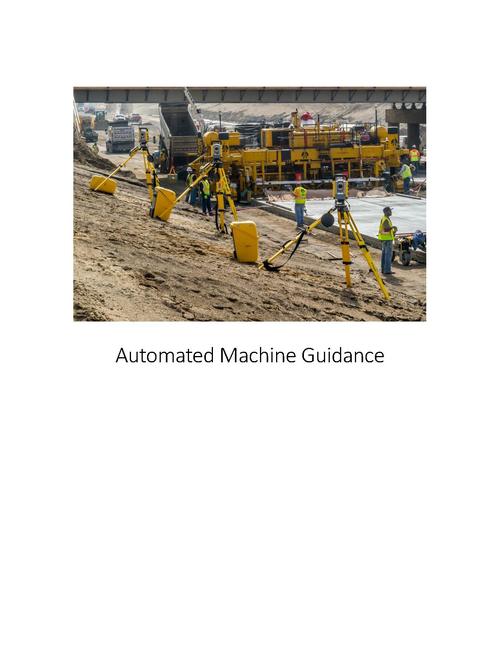
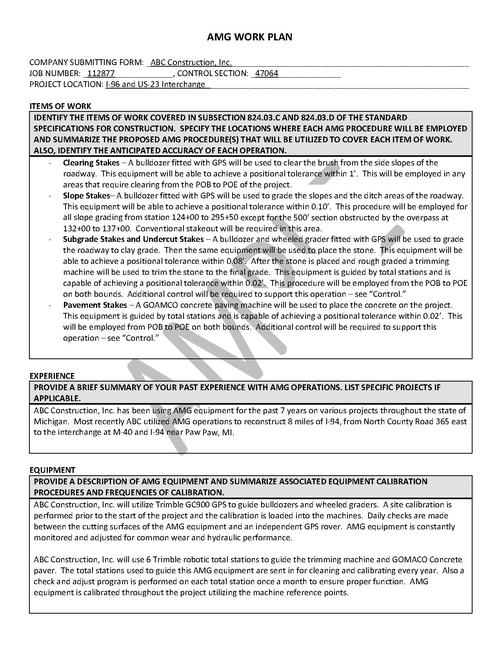
The following information will serve as guidance for the administration of projects that incorporate the Special Provision for Automated Machine Guidance (AMG). The documentation is specific for AMG projects and supplements information for the Engineer in the special provision for the administration of AMG work. These procedures apply to all federal and state funded projects that use the AMG process.
As-Built Plans
Preparation of as-built plans should follow the guidelines set forth in section 109.07 109.07 Final Marked Plans and Section 14.73.01 of the MDOT English Road Design Manual.
INSPECTION & TESTING
-Reserved-
MEASUREMENT, DOCMENTATION & PAYMENT
-Reserved-