203 - Removing Drainage Structures, Culverts, and Sewers
GENERAL DESCRIPTION
Definitions of Terms
Abandon: Abandon refers to leaving an existing facility in place and making it unusable. This often involves breaking it down to a safe depth below the final road surface, placing flowable fill grout or low-density cellular concrete, and bulkheading existing pipes.
Catch Basin: A catch basin is a structure within a storm sewer system that is utilized to collect surface water.
Culvert: A culvert is a structure with a clear span less than 20 feet used to channel water under a road, railway, or embankment.
Drainage Structure: A drainage structure is a structure within a storm sewer system that collects water from the surface and directs it through an underground sewer system. A drainage structure may be utilized to facilitate bends or turns in the sewer pipe.
Manhole: A manhole is a structure within a sewer system that is utilized to facilitate bends or turns into the sewer pipe and allows access to the sewer system.
Sewer: A sewer is a pipe or conduit used to carry storm water and/or wastewater from roadways, homes, businesses, and industrial facilities.
Sump: A sump is the lower portion of a catch basin below the outlet pipe that is used to settle out debris and suspended material prior to storm water exiting the catch basin.
General Overview
Removing drainage structures, culverts, and sewers can involve complete removal or abandonment. Typically, existing facilities are removed then new facilities are built in the same location. In some cases, existing functional pipes might be extended to fit the new design. It is crucial to maintain sewer service during construction. To ensure minimal disruption, new sewer may be constructed before or in conjunction with work on the existing sewer.
MATERIALS
All materials must meet acceptance requirements in the Materials Source Guide and be listed on the Contractor-provided Material Source Lists in the project files.
Description of Materials
Granular Material (Class III)
Granular backfill, often comprised of sand, is used to fill the space after existing features are removed. Refer to Section 902 of the Standard Specifications for Construction for material requirements.
Sound Earth
Sound earth typically refers to soil that is stable and suitable for supporting the weight and traffic loads of the road surface. Sound earth is free from excessive moisture, organic matter, and other contaminants that could compromise its stability or load-bearing capacity. Refer to Section 205 of the Standard Specifications for Construction for material requirements of sound earth.
Brick and Block
Brick and block are rectangular in shape and typically made of concrete. Blocks tend to be larger than bricks and may have hollow cores for lighter weight or insulation.
Bulkhead
A bulkhead is a barrier or plug installed at the end of a sewer pipe to seal off and abandon the pipeline. The bulkhead prevents the flow of water or debris through the pipe, effectively closing off the sewer system. Typically made of concrete, or other durable materials such as brick and block, bulkheads are designed to withstand hydraulic pressure and environmental factors. The abandonment of sewers may occur due to changes in drainage patterns, infrastructure upgrades, or the decommissioning of outdated systems.
Pictures of Materials


EQUIPMENT
The following equipment can be used:
- Excavator
- Front end loader
- Dump truck
- Bulldozer
- Forestry equipment
- Cutoff saw
- Plate or jumping jack compactor
- Portable concrete mixer
Pictures of Equipment
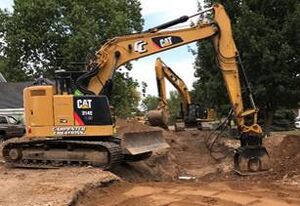
Excavator with Plate Compactor Attachment (Ho-Pac)
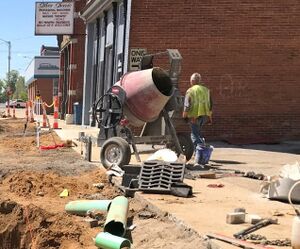
Portable Concrete Mixer

Plate Compactor
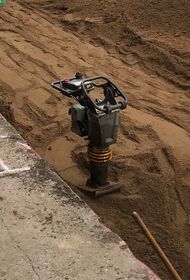
Jumping Jack Compactor
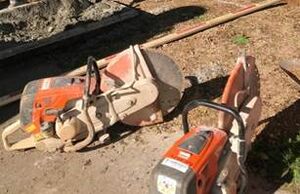
Cutoff Saws


PRECONSRTUCTION
The Inspector should perform the following prior to the start of construction:
- Review the plans to verify the location of the work.
- Verify items called out to be removed, and whether they will be completely or partially removed.
- Verify MISS DIG has flagged existing private or MDOT utilities.
- Verify a surveyor has provided stakes for the work.
- Review all pertinent environmental restrictions. This will be included within the project plans, special provisions, and/or permits.
- Review the plans and the Special Provision for Maintenance of Traffic. There may be restrictions or staging requirements. Installation restrictions are typically associated with staging requirements on a project and access to side streets and driveways.
- Verify all materials are approved for use and meet specifications, and verify stockpiled materials are protected from weather and sunlight as required by the specifications and manufacturer recommendations.
- Obtain photographs of material tickets, storage method, and location.
- Hold an onsite meeting with the Contractor to discuss:
- The construction methods that will be used to complete the work.
- Methods or operations that will be used if existing facilities must be maintained during the work.
- Required traffic control measures, proximity of traffic to the work area, and maintaining driveways during construction.
- Communication required if impacting residents or businesses during installation.
- Residents and businesses should be contacted if there will be disruptions to services. Coordination by the Contractor with impacted users may be required if disruption is necessary.
- Review of local ordinances.
- Disposal of excavated material and material stockpile locations. The Contractor should provide authorization letters to the Engineer noting material stockpile and disposal locations.
- Soil erosion and sedimentation control measures that will be utilized to minimize soil erosion and subsequent sedimentation.
- Environmental restrictions associated with the project site.
- Methods for securing the site during work operations and at the end of each workday.
CONSTRUCTION
Construction involves selective removal or abandonment of drainage structures, culverts, and sewers. Salvaged materials will be stored and disposed of according to regulations. Excavated sites will be backfilled with appropriate material and compacted to ensure stability.
Structure Removal
Structure removal includes sanitary sewer manholes, storm sewer drainage structures, and catch basins. When the plans call for structure removal, the Contractor will remove the existing structure in its entirety. Materials should be disposed of in accordance with Subsection 205.03.P of the Standard Specifications for Construction.
For structures shown on the plans as abandon, the Contractor will remove the cover and break down the masonry in accordance with Subsection 204.03 of the Standard Specifications for Construction.
Backfill should be in accordance with Subsection 204.03.C of the Standard Specifications for Construction.


Culvert Pipe Removal
Where called for on the plans, the Contractor will remove the culvert in its entirety, including end sections. If the plans call for the partial removal, what is shown on the plans should be removed. If portions of the culvert to remain in place are damaged during removal of adjacent features, the Contractor must make the necessary repairs at no additional cost to the contract.


Sewer Removal
Live sewer services must be maintained during construction operations. The Contractor will remove sewers or portions of sewers as required or that interfere with the new construction. The Contractor must remove only the portion of existing sewer necessary to allow the required connection to the new work. If damages are incurred to the existing sewer to remain in place, the Contractor must make the necessary repairs at no additional cost to the contract.


Bulkhead
The Contractor will place either Grade 3000 concrete or brick/block masonry, with grout, at a minimum of 1 foot into the sewer that is called to be abandoned. This will provide a seal to prevent debris and water from getting into the sewer pipe. Refer to Subsection 402.03.E of the Standard Specifications for Construction for more information on bulkheading.


INSPECTION & TESTING
Inspection
The Inspector should utilize, at a minimum, the following tools to perform the required inspection:
- 100-foot tape measure or longer
- 25-foot tape measure
- 6-foot stick ruler
- Working plans
- Camera
The Inspector should take the following steps during construction:
- Monitor the removal operation to ensure that cross-contamination of other materials does not occur.
- If the plans call for a partial removal of a culvert or sewer, photograph the existing sewer prior to the start of work and during the work operation to verify no damage was done during construction.
- If abandoning in place, verify that bulkhead is placed correctly or flowable fill is placed within the pipe properly.
- Obtain material tickets.
- Verify the backfill is uniformly compacted in layers to provide adequate support and stability.
- Record the density testing results of the backfill material in accordance with the Density Testing and Inspection Manual using the field established maximum density for the material being tested. The minimum testing frequency is shown in Appendix K (backfill) of this manual. The testing frequencies listed are minimums that are satisfactory for acceptance. However, it is emphasized that project conditions normally require more frequent testing for proper density control.
Special Attention Areas
If the plans call to extend or incorporate existing pipe, the Inspector should verify the Contractor only removes the portions of existing sewer pipe necessary to make the required connections to the new work. There may be a special provision which specifies the type of connection between the existing and new pipes. The Inspector should also verify there is no damage the existing pipe to remain. The Contractor must repair any damage to existing pipe at no expense to the contract.
Any culvert or sewer pipes with a top elevation within 5 feet of the top of pavement called to be abandoned, must have the abandonment treatment reviewed by the Engineer.
Testing
Perform density testing on compacted backfill. All backfill, regardless of material used, is to be compacted to at least 95% of the maximum unit weight.

MEASUREMENT, DOCUMENTATION AND PAYMENT
Measurement and Payment
Unless otherwise required, structures or materials are measured in the original positions. Elliptical or pipe arch culverts are measured across the greatest dimension.
The Contractor will be paid for bulkheading sewers larger than 12 inches in diameter, otherwise the cost is included in the work.
Unit prices for pay items include the cost of breaking down structures and material; sawing, removal, and disposal; providing, placing, and compacting backfill; and providing and placing replacement soil or base material.
Pay items for removal of drainage structure, culverts, and culvert end sections are paid for by each item. Abandonment of any drainage feature is also paid for by each occurrence. Sewer removal is paid for by the linear foot of sewer removed. Some items, like culverts, culvert end sections, and sewers, will have a size (diameter) associated with the item being removed.
Documentation
The Daily Work Report (DWR) should show all measurements, computations, and supporting documentation needed to verify the quantity submitted for payment. The Inspector should note in the remarks section of the report the material verification and equipment used for the delivery and placement of backfill material. Each load ticket must include the required information. Refer to Subsection 109.01.B.6 of the Standard Specifications for Construction for the information required on each ticket.
Form 0582B, Moisture & Density Determination - Nuclear Method, is used to record density testing results.
LOCAL AGENCY PROJECTS
-Reserved-
RAIL PROJECTS
-Reserved-